Send a message. Get an answer. Leave a note for someone to read later.
Those sound like ordinary phone activities. Around Nacogdoches, they’re also becoming part of an experimental radio network that can carry local messages without cellular service or an internet connection.
Club member and Public Information Officer Andy Delgado, KE5EXX, has been building and testing the pieces of EastTexasMeshNet. His latest progress includes working radio mailboxes, another solar repeater ready for deployment, and tools to help understand how the network behaves.
Small radios, a growing idea
The project uses MeshCore, software that lets compatible radio devices exchange short text messages. A phone or computer provides a familiar place to type and read, while the connected radio carries the message over the air.
Repeaters can relay those messages farther when suitable radio paths are available. Trees, buildings, terrain, and antenna placement still affect whether a message gets through.
The local project welcomes people without an amateur radio call sign, too. That makes it an opportunity for curious neighbors to explore radio alongside experienced hams.
Following his November 3 presentation to the Nacogdoches Amateur Radio Club, Andy created a project website and posted the recorded presentation. The site now includes equipment information, a build journal, and guides for newcomers.
A mailbox you reach by radio
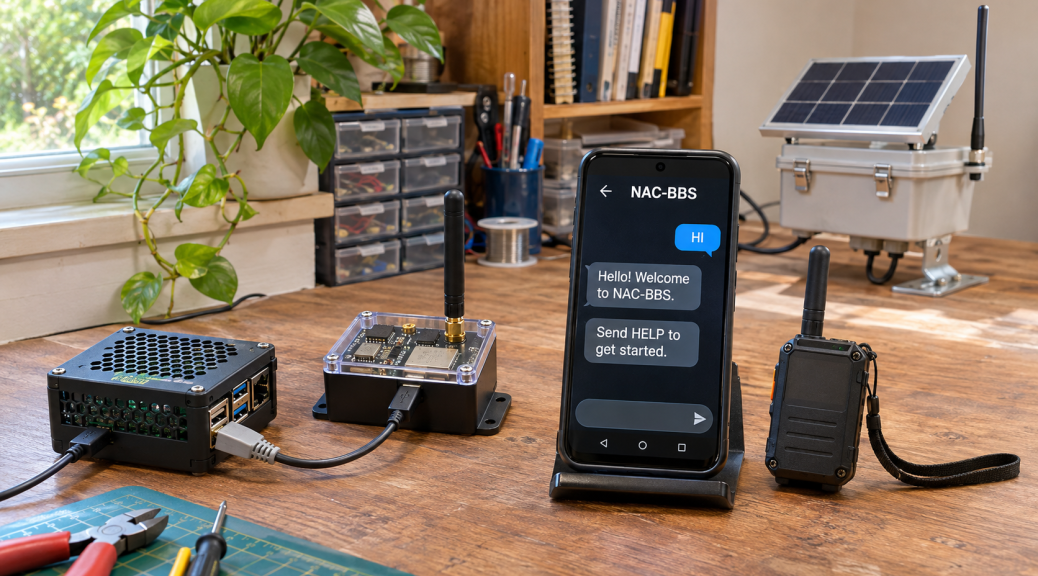
One of the biggest steps forward is NAC-BBS, an experimental bulletin board and mailbox system.
A bulletin board system, or BBS, is a computer that responds to commands and stores information. This one runs on a Raspberry Pi, a small computer connected to a MeshCore radio.
The first tests proved that a message could travel from a radio to the computer, receive a response, and come back over the air.
Now users can register a mailbox name, leave messages for other registered users, and retrieve their mail when they reconnect. There’s also a directory, short user profiles, and improved help instructions.
Even saying “HI” gets a useful response. That’s a friendlier beginning than being greeted by a blinking cursor and a mystery.
The system also provides local time and weather information. Forecasts are downloaded when internet access is available and stored locally. During an internet outage, it can share the last downloaded forecast, although that information will become older until updates resume.
More equipment ready for testing
Andy has converted a donated solar-powered unit from Meshtastic to MeshCore and named it NAC-RPT-02. It’s ready for deployment once a suitable location is found.
He also assembled a small radio station called NAC-MON-01 for research, testing, and monitoring. It has already communicated successfully with other project equipment.
That gives the project a way to try ideas and observe connections before making wider changes.
NAC-RPT-01 is now installed on the roof of the Fredonia Hotel, approximately 100 feet above ground level. We’re testing its coverage area now and will share what we learn as measurements come in.
Watching the network grow
The website’s Activity page shows devices recently heard by NAC-BBS. It’s a view from one listening station, rather than a count of every MeshCore device in East Texas.
The public information excludes private message contents and mailbox names. Website reporting also operates separately from local messaging, so losing the internet connection doesn’t stop the BBS’s radio functions.
Behind the scenes, startup reports and remote administration make maintenance easier. A backup BBS system is being planned, but hasn’t been put into service.
Come follow the build
EastTexasMeshNet remains a developing project. A regional connection between Nacogdoches and Lufkin is a goal, and this experimental network isn’t a replacement for emergency services.
But working mailboxes and successful radio exchanges are concrete progress.
Visit the MeshCore project website and Build Journal to follow along, watch the presentation, or ask Andy a question. If experimenting with a few small radios sounds interesting, there’s room to learn together.