Category Archives: Blog Posts

How Far Can a Ham Radio Reach?

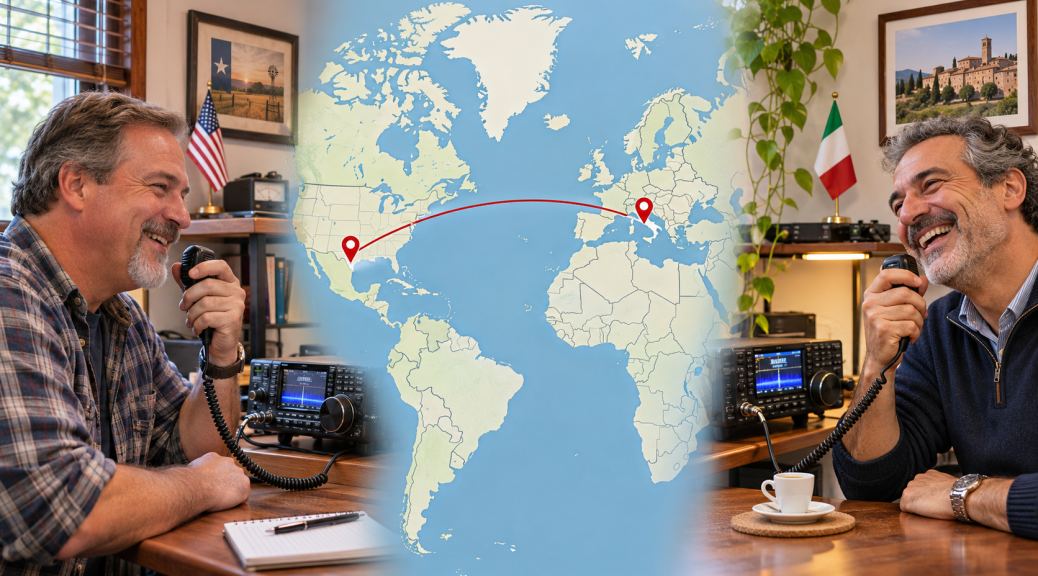
Across town, across the world, or even into space.

That’s the fun answer. The useful answer starts with two words that amateur radio operators say quite often: “It depends.”

A small handheld radio might reach someone nearby. A different radio connected to a suitable antenna could make contact with another continent. And some operators use equipment that communicates through satellites.

So why isn’t there one simple mileage number printed on every radio box?

Across town: a good place to start

Many handheld and vehicle-mounted ham radios use frequencies that work best with a reasonably clear path between antennas. Buildings, hills, trees, and antenna height can all affect that path.

Two people using handheld radios at ground level might have trouble reaching each other across a built-up area. Move to higher ground or use a better-positioned antenna, and the result could improve considerably. That’s one reason experienced operators pay attention to where the antenna goes.

Here in East Texas, a radio signal may have to contend with rolling terrain and plenty of pine trees. A setup that works well from an open hilltop may behave differently inside a building.

There isn’t a dependable rule that says every handheld reaches a certain number of miles.

Repeaters lend a helping hand

A repeater is a station that receives a radio signal and retransmits it. Its antenna is often placed somewhere high, giving it a clearer view of the surrounding area.

Instead of trying to reach another person directly, your handheld may reach the repeater. The repeater then passes your voice along to other operators within its coverage area. That can extend local communication well beyond what two handhelds could manage alone.

Think of it as getting your message up where more people can hear it.

Some systems also link repeaters using radio connections or the internet. A conversation might travel a great distance through those links, although that doesn’t mean the handheld’s own signal crossed the country.

Around the world, with help from the sky

Other amateur radio frequencies can take a different route.

Under suitable conditions, signals can bend back toward Earth through a region high in the atmosphere called the ionosphere. This allows communication far beyond the horizon, sometimes over thousands of miles.

The best frequency can change with the time of day, season, and activity on the sun. A path that works beautifully one afternoon might be quiet the next.

That changing puzzle is part of the attraction. Operators try different frequencies, antennas, and ways of communicating to see whom they can reach.

Making an overseas contact doesn’t always require a huge tower. With suitable equipment, an effective antenna, and favorable conditions, a modest station can make distant contacts. More transmitter power alone doesn’t determine the outcome.

Yes, space is part of the hobby

Amateur radio satellites can receive signals from operators on Earth and relay them to other locations. For many satellites, operators plan around the brief period when the satellite is above the horizon for both stations.

Amateur radio also connects people with the International Space Station. Through the ARISS educational program, students participate in scheduled conversations with crew members. Some astronauts also make occasional unscheduled contacts with licensed operators when their duties allow.

You can’t simply call an astronaut whenever you feel like it. But the possibility certainly adds a little excitement to pointing an antenna skyward.

The distance is only part of the fun

Radio range depends on the whole setup: frequency, equipment, antennas at both ends, terrain, conditions, and operating method.

Sometimes the goal is a dependable conversation across Nacogdoches. Sometimes it’s seeing whether someone on another continent answers. Both can be satisfying.

Curious about what you could try? Visit w5nac.com to learn more about the Nacogdoches Amateur Radio Club, W5NAC, and consider coming to a meeting.

Bring your questions. “How far can it reach?” is a perfectly good first one.
MeshCore Presentation in Nacogdoches | November 3, 2026

What if you could send text messages across town without using a cell tower, Wi-Fi network, or Internet connection?

That is one of the ideas behind MeshCore, and we’ll take a closer look at it at the next meeting of the Nacogdoches Amateur Radio Club.

The presentation will be held:

Tuesday, November 3, 2026 at 7:00 PM
Nacogdoches County Emergency Operations Center
727 FM 3314, Nacogdoches, TX 75964

Need help finding the EOC? Visit our directions page.

What Is MeshCore?

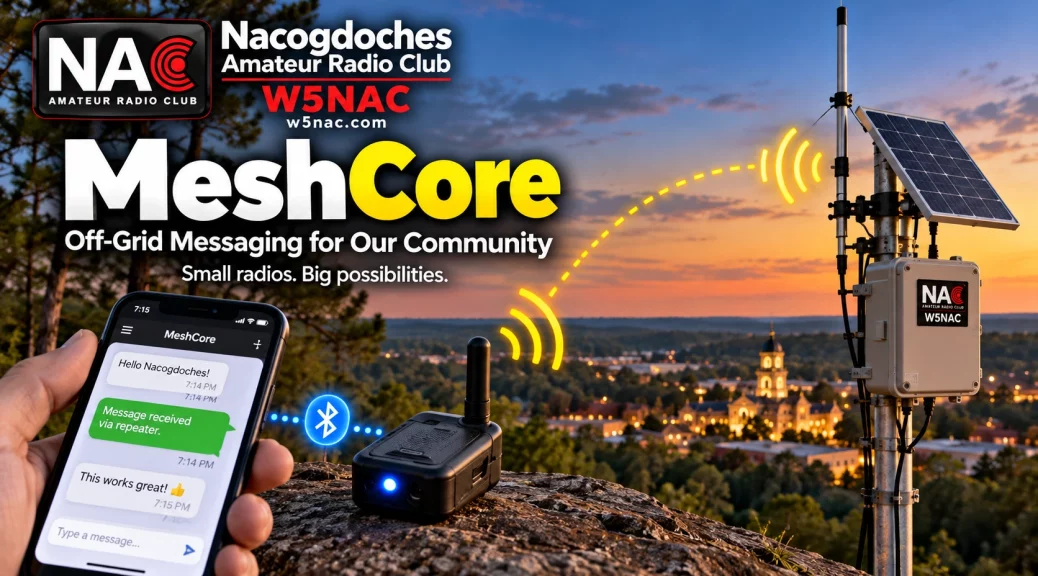
MeshCore is a communications system that uses small LoRa radios to send digital messages over radio.

A personal MeshCore device can connect to a smartphone through Bluetooth. Your phone gives you the screen and keyboard, while the small radio handles the actual radio communication.

Dedicated repeaters can then help those messages travel farther.

In simple terms, it can look something like this:

Phone → Personal Radio → Repeater → Another Radio → Another Phone

The local radio network can continue working without depending on the Internet.

What Will We Demonstrate?

Andy Delgado, KE5EXX, will share some of the MeshCore equipment he has been experimenting with and explain how the pieces work together.

The presentation will include personal Companion nodes that connect to a phone by Bluetooth, along with a solar-powered MeshCore repeater that can operate independently from normal household power.

We will also look at some of the ideas we have been exploring for a local network around Nacogdoches.

That includes placing repeaters at useful locations, extending coverage from one part of the community to another, and eventually exploring things such as Room Servers and optional Internet gateways.

No, we are not building Skynet.

At least not Tuesday night.

Why Is This Interesting to Amateur Radio Operators?

MeshCore is not a replacement for amateur radio, public-safety communications, or cellular service.

It is another technology worth learning about.

For amateur radio operators, it combines several familiar ideas:

  • radio propagation
  • antennas and elevation
  • repeaters
  • solar-powered equipment
  • portable communications
  • network planning
  • experimentation

It also gives us a chance to work with technology that may be useful in places where ordinary Internet or cellular coverage is limited.

And because the equipment is relatively small and low-powered, it opens up some interesting possibilities for portable and remotely powered installations.

Could We Build a Local Network?

That is one of the questions we want to explore.

Imagine several repeaters around Nacogdoches. Personal nodes could communicate through whichever repeater or path was available.

Later, other communities could build their own local networks and experiment with ways to connect them.

We are still very much in the learning and testing stage, which is part of the fun.

Rather than starting with a finished system and a stack of claims about what it can do, we want to build it, test it, measure it, and learn from the results.

Everyone Is Welcome

You do not need to own a MeshCore radio.

You do not need to understand LoRa.

You do not even need to be an amateur radio operator to find the technology interesting.

If you are curious about radio, mesh networking, off-grid communications, solar-powered electronics, or just enjoy seeing new technology in action, we would be glad to have you join us.

Tuesday, November 3 at 7:00 PM.

Come see what we have been experimenting with and help us explore where this might go next.

Why Ham Radio Still Matters in 2026

Your phone can send a photo across the world before your coffee cools. You can stream a movie, join a video call, or ask artificial intelligence to help plan dinner.

So why would anyone still want a ham radio?

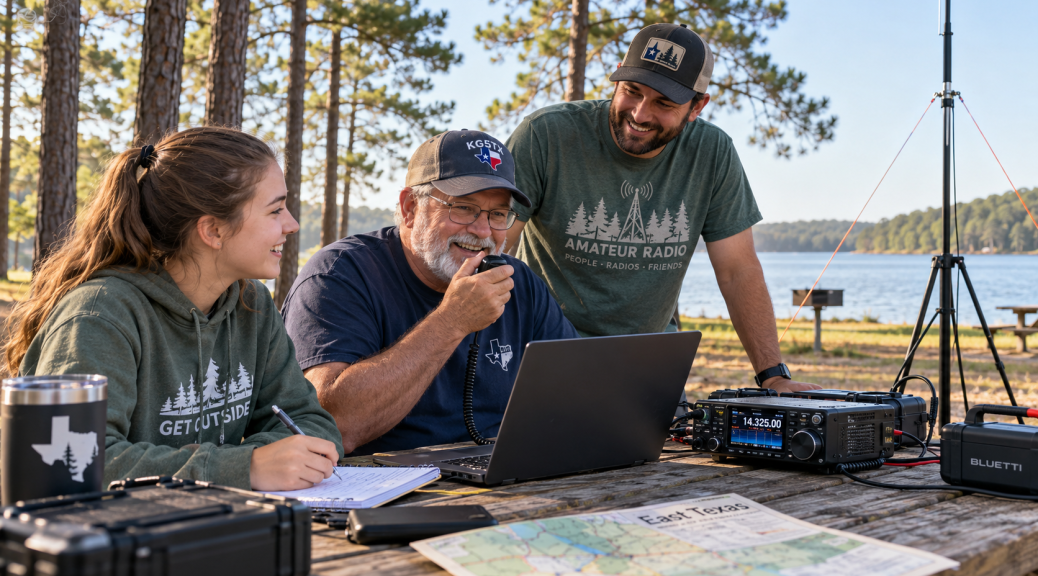
Picture someone at an East Texas picnic table with a compact radio, a battery, and an antenna. A voice answers from hundreds of miles away. Getting that answer took a little planning, some learning, and perhaps a few adjustments.

The connection is part of the fun. Figuring out how to make it happen is another.

A different way to connect

Amateur radio, often called ham radio, lets licensed operators communicate and experiment using radio equipment. Depending on the frequency, equipment, antenna, conditions, and operating method, contacts can reach across town, across the country, or into other countries.

A cellphone normally relies on a network of towers, connections, power, and service providers. Ham radio can provide direct communication between stations without those same commercial networks.

That doesn’t make every ham radio setup independent. Some use repeaters, which receive and retransmit signals to extend coverage. Others use internet links or commercial power. Operators choose different tools for different purposes.

Having another way to communicate is useful. Learning how that connection works can be just as rewarding.

The equipment has kept evolving

If you picture ham radio as a dusty desk covered in glowing tubes, there’s quite a bit to catch up on.

Modern stations can combine radios with computers, digital voice, GPS location information, and mapping software. Software-defined radios use software to handle tasks once performed by dedicated electronic circuits.

Some operators exchange short digital messages using signals too faint for an ordinary voice conversation. Others make contacts through amateur radio satellites passing overhead.

A smartphone usually hides the complicated technology so you can get on with your day. Amateur radio gives you a chance to explore it.

You can adjust an antenna, try different software, or compare two setups and discover why one works better. You don’t need to be an engineer to begin. Learning is part of the hobby.

Sometimes the best radio room has pine trees

A ham radio station doesn’t have to occupy a spare bedroom.

Portable equipment, rechargeable batteries, and temporary antennas let operators take the hobby to parks, campsites, and other outdoor locations. A station can be simple enough to pack up when it’s time to head home.

Here in East Texas, it’s easy to see the appeal of combining time outdoors with a little radio experimenting. There might be a conversation with someone nearby, a distant contact, or an afternoon spent improving the setup.

And if the contacts are slow, you’re still outside among the pines. There are worse ways to spend an afternoon.

Useful skills, with a practical purpose

Public service is another part of amateur radio. Volunteers help with communications at public events and, with appropriate training and coordination, during severe weather and emergencies.

Ham radio can supplement normal communications when appropriate. Its usefulness depends on prepared operators, working equipment, power, and a suitable path for the signal. It doesn’t replace professional emergency systems or guarantee that a message will get through.

Not every ham focuses on emergency work. Some enjoy contests, collect contacts from different places, build equipment, or catch up with friends. Those are all reasons to turn on a radio, too.

There are people behind the signals

For many operators, the lasting connections are friendships.

A shared interest gives people from different generations and backgrounds something to explore together. Someone helps solve an antenna problem. Someone else explains a new program. Before long, a technical question turns into a good conversation.

That’s why ham radio still matters in 2026. It keeps evolving, giving people new things to try and new reasons to connect.

Curious? Visit w5nac.com to learn about the Nacogdoches Amateur Radio Club, W5NAC. Bring your questions and consider visiting a meeting. You don’t have to know how it all works to come see what it’s about.