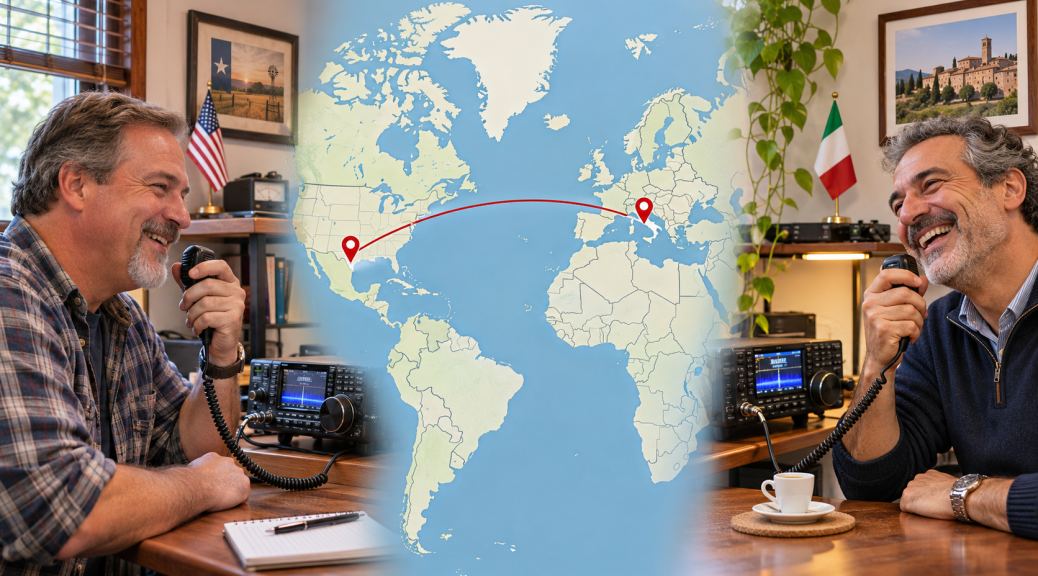
Across town, across the world, or even into space.
That’s the fun answer. The useful answer starts with two words that amateur radio operators say quite often: “It depends.”
A small handheld radio might reach someone nearby. A different radio connected to a suitable antenna could make contact with another continent. And some operators use equipment that communicates through satellites.
So why isn’t there one simple mileage number printed on every radio box?
Across town: a good place to start
Many handheld and vehicle-mounted ham radios use frequencies that work best with a reasonably clear path between antennas. Buildings, hills, trees, and antenna height can all affect that path.
Two people using handheld radios at ground level might have trouble reaching each other across a built-up area. Move to higher ground or use a better-positioned antenna, and the result could improve considerably. That’s one reason experienced operators pay attention to where the antenna goes.
Here in East Texas, a radio signal may have to contend with rolling terrain and plenty of pine trees. A setup that works well from an open hilltop may behave differently inside a building.
There isn’t a dependable rule that says every handheld reaches a certain number of miles.
Repeaters lend a helping hand
A repeater is a station that receives a radio signal and retransmits it. Its antenna is often placed somewhere high, giving it a clearer view of the surrounding area.
Instead of trying to reach another person directly, your handheld may reach the repeater. The repeater then passes your voice along to other operators within its coverage area. That can extend local communication well beyond what two handhelds could manage alone.
Think of it as getting your message up where more people can hear it.
Some systems also link repeaters using radio connections or the internet. A conversation might travel a great distance through those links, although that doesn’t mean the handheld’s own signal crossed the country.
Around the world, with help from the sky
Other amateur radio frequencies can take a different route.
Under suitable conditions, signals can bend back toward Earth through a region high in the atmosphere called the ionosphere. This allows communication far beyond the horizon, sometimes over thousands of miles.
The best frequency can change with the time of day, season, and activity on the sun. A path that works beautifully one afternoon might be quiet the next.
That changing puzzle is part of the attraction. Operators try different frequencies, antennas, and ways of communicating to see whom they can reach.
Making an overseas contact doesn’t always require a huge tower. With suitable equipment, an effective antenna, and favorable conditions, a modest station can make distant contacts. More transmitter power alone doesn’t determine the outcome.
Yes, space is part of the hobby
Amateur radio satellites can receive signals from operators on Earth and relay them to other locations. For many satellites, operators plan around the brief period when the satellite is above the horizon for both stations.
Amateur radio also connects people with the International Space Station. Through the ARISS educational program, students participate in scheduled conversations with crew members. Some astronauts also make occasional unscheduled contacts with licensed operators when their duties allow.
You can’t simply call an astronaut whenever you feel like it. But the possibility certainly adds a little excitement to pointing an antenna skyward.
The distance is only part of the fun
Radio range depends on the whole setup: frequency, equipment, antennas at both ends, terrain, conditions, and operating method.
Sometimes the goal is a dependable conversation across Nacogdoches. Sometimes it’s seeing whether someone on another continent answers. Both can be satisfying.
Curious about what you could try? Visit w5nac.com to learn more about the Nacogdoches Amateur Radio Club, W5NAC, and consider coming to a meeting.
Bring your questions. “How far can it reach?” is a perfectly good first one.